
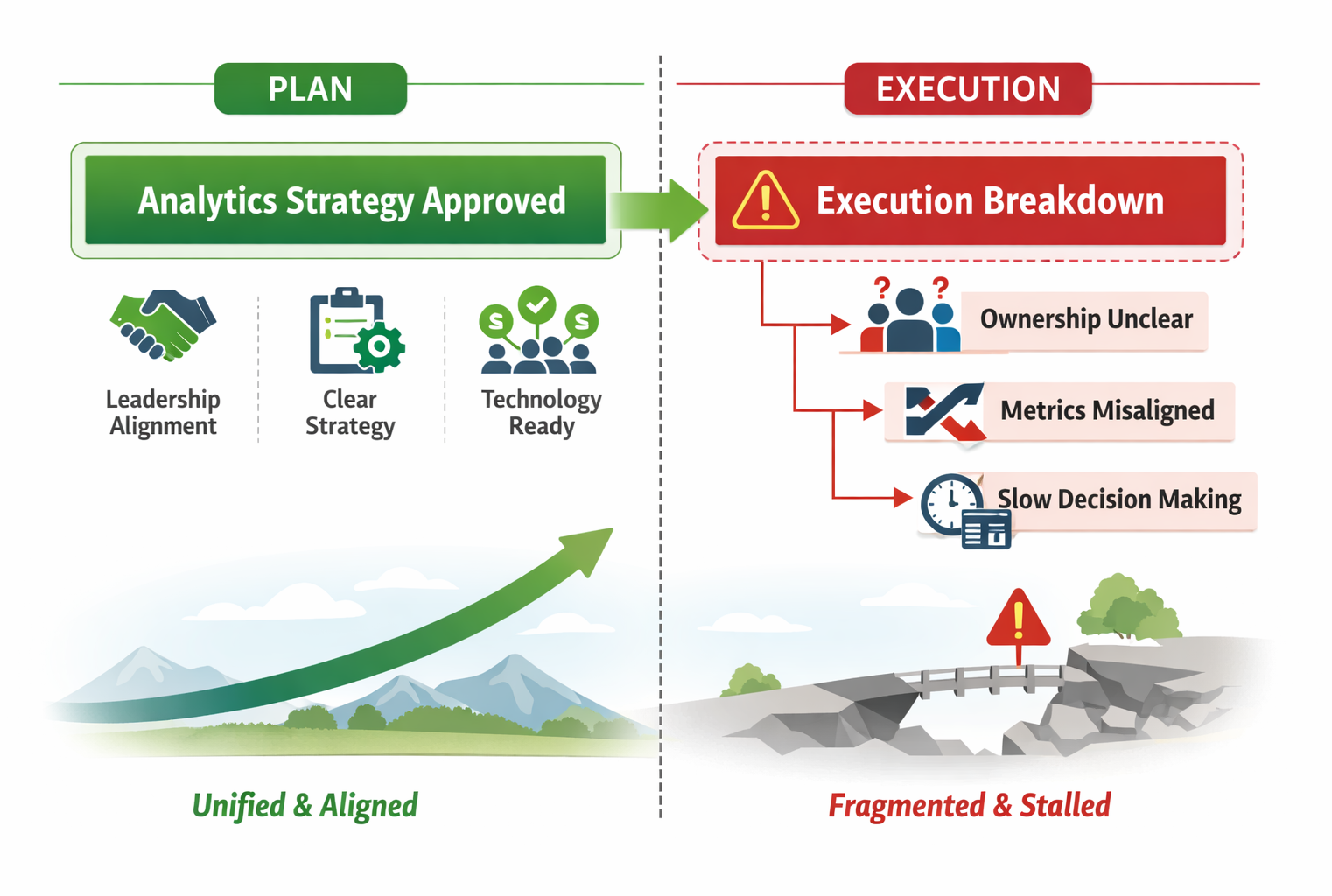
Most analytics strategies do not fail because they were poorly designed. They fail after approval, when execution begins and real decisions start depending on real data. This is where analytics execution failure quietly shows up inside otherwise capable organizations. This is why analytics strategy failure often surprises leadership teams long after planning is complete.
Dashboards exist. Data teams are active. Modern tools are in place. Yet when pressure rises, leaders still hesitate, question the numbers, or fall back to spreadsheets and gut instinct. The strategy looks sound on paper, but execution breaks in ways the planning phase never exposed.
This is not a tooling problem. It is an execution problem that sits between data production, ownership, and decision-making.
Why Analytics Strategies Fail After Planning
Most organizations do not struggle because they lack an analytics strategy. By the time a strategy is approved, it has usually passed alignment sessions, leadership reviews, and technology evaluations. On paper, it is coherent and well-intentioned.
The breakdown happens later.
Once execution begins, the strategy collides with operational reality. Ownership becomes ambiguous. Metrics that appeared aligned during planning start to drift across teams. Decision contexts change faster than reporting cycles. What looked unified in workshops becomes fragmented in daily use.
Research on strategy execution failure shows that strategies most often fail because accountability and alignment break down after approval, not because the strategy itself is flawed.
Where Analytics Strategy Execution Breaks Down
Execution failure rarely happens all at once. It shows up in small, compounding moments that teams initially dismiss as temporary friction.
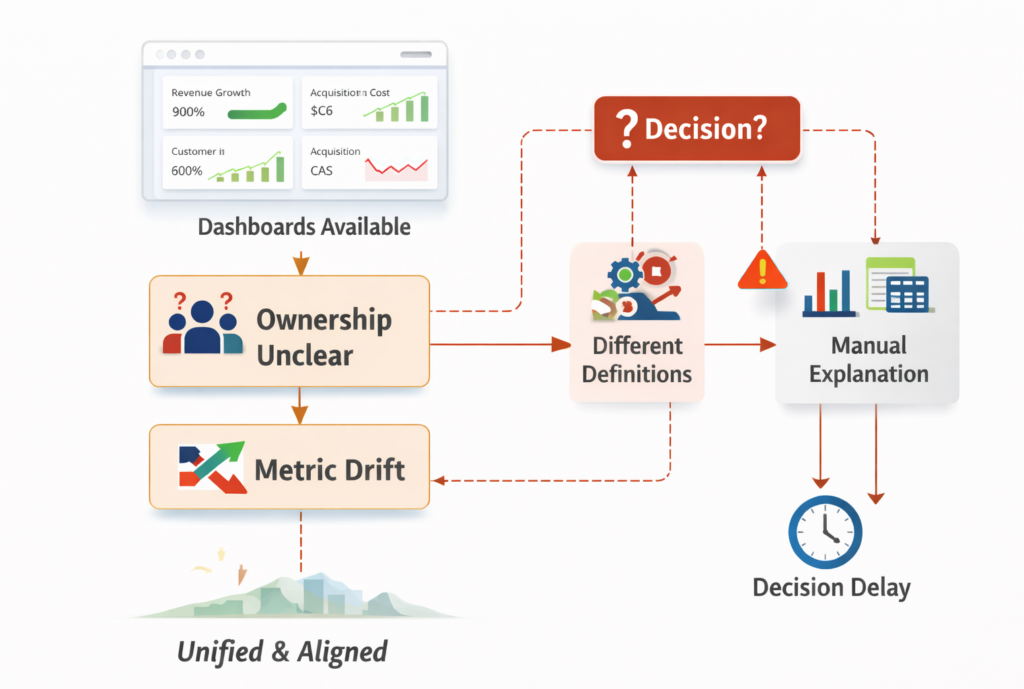
Decision makers ask the same question in multiple meetings and receive different answers. Teams debate definitions instead of acting. Reports arrive late or require manual explanation. Dashboards technically work, but they slow decisions instead of accelerating them.
This is the strategy to execution gap in practice. Even strong models fail when execution lacks alignment and ownership.
In analytics environments, this gap often surfaces as dashboard-driven decision lag, where reporting exists but confidence does not.
Why Dashboards Do Not Fix Execution by Themselves
Dashboards are often treated as the solution to execution problems. When analytics struggles, organizations respond by building more dashboards, adding new metrics, or redesigning visuals.
This rarely fixes the underlying issue.
Dashboards reflect execution maturity; they do not create it. Without clear data governance and ownership, dashboards simply surface disagreements faster.
When governance is weak, dashboards amplify confusion instead of resolving it. Execution does not improve because the structural issues remain untouched.
What Leaders Must Do Differently to Fix Execution Failure
Fixing analytics execution failure requires a shift in leadership focus. The question is not whether dashboards look good, but whether decisions reliably follow from them.
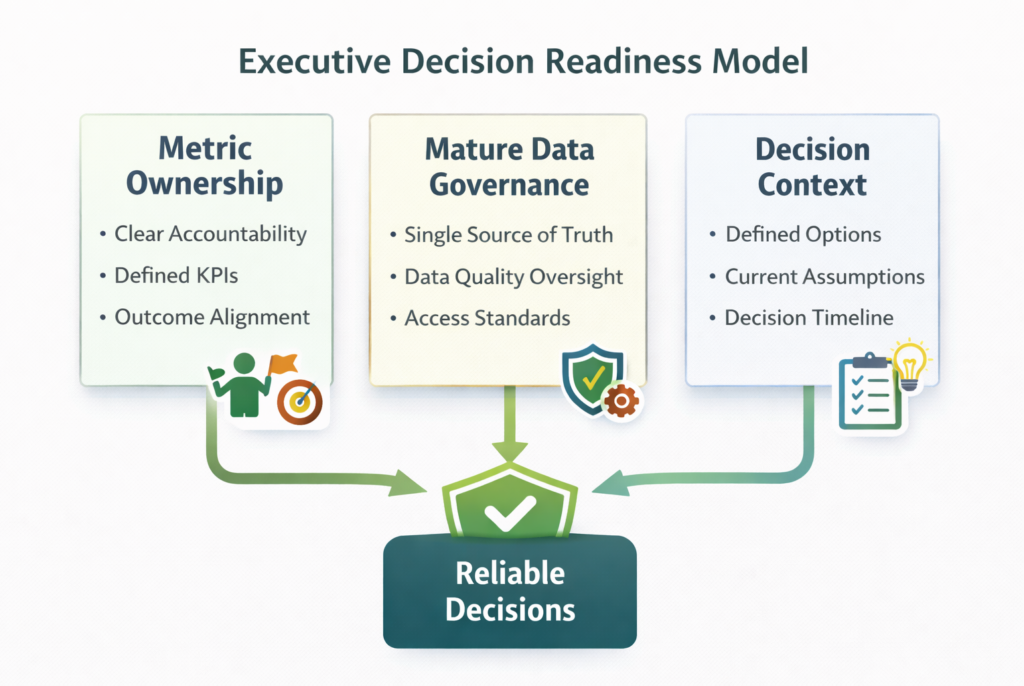
Leaders must clarify who owns each metric, how definitions are maintained, and what decisions each report is meant to support. Execution improves when accountability is explicit and decision paths are short.
Under pressure, weak execution becomes visible immediately. Dashboards that worked during calm periods fail when urgency increases and ambiguity is no longer tolerable.
How Swift Insights Approaches Analytics Execution
Swift Insights approaches analytics execution as an operational system, not a reporting exercise. The focus is not on producing dashboards faster, but on ensuring that data reliably supports real decisions under pressure.
This means addressing execution foundations first: ownership, governance, decision context, and delivery discipline. Dashboards are built only after these elements are clear, so they accelerate action instead of creating friction.
By treating analytics as decision infrastructure rather than a visualization problem, Swift Insights helps organizations move from planning confidence to execution reliability.
Conclusion
Analytics strategies rarely fail because they are poorly conceived. They fail because execution breaks down once plans meet reality. Without clear ownership, governance, and decision alignment, even the best strategies stall after launch.
Execution failure is not inevitable. It is structural, diagnosable, and fixable. Organizations that address execution deliberately move beyond dashboards that report activity and toward analytics that consistently drive decisions.
The difference is not better planning. It is better execution.