
Most mid-market companies do not have a data problem in the way people usually mean it. They are not short on numbers. If anything, they have too many. Those numbers are spread across too many systems, owned by too many different people, each one confident their version is the right one. The costly data mistakes that stall good decisions almost never come from the people in the room. They come from what those people are working from.
The pattern shows up in a Monday meeting where two department heads pull up two different revenue numbers for the same month, and nobody can say with confidence which one is correct. A decision that should take an afternoon takes two weeks instead. Someone has to manually reconcile three spreadsheets before anyone can act. Then the person who actually built the report leaves the company, and suddenly nobody trusts that report either.
None of that is a data problem in the sense of not having enough information. It is a decision problem, and it is costing companies real time and real money every single week. According to Harvard Business Review, poor data quality drains an estimated three trillion dollars a year from the U.S. economy. Most of that cost comes from exactly this kind of stalled decision, not from any single dramatic failure.
How Costly Data Mistakes Quietly Pile Up as a Company Grows
There is a big difference between collecting data and being able to act on it. A company can have a CRM, an ERP, a marketing platform, and a handful of spreadsheets, all producing numbers constantly. Even so, the people running the company can still walk into a room without a straight answer.
That gap tends to grow quietly. Nobody decides on purpose to end up with five sources of truth. A sales manager builds a personal tracking sheet because the CRM report does not quite match what they need. A finance person adjusts a formula in Excel to correct for something the system does not handle well. Two years later, three people are confidently reporting three different numbers, each one right according to their own math.
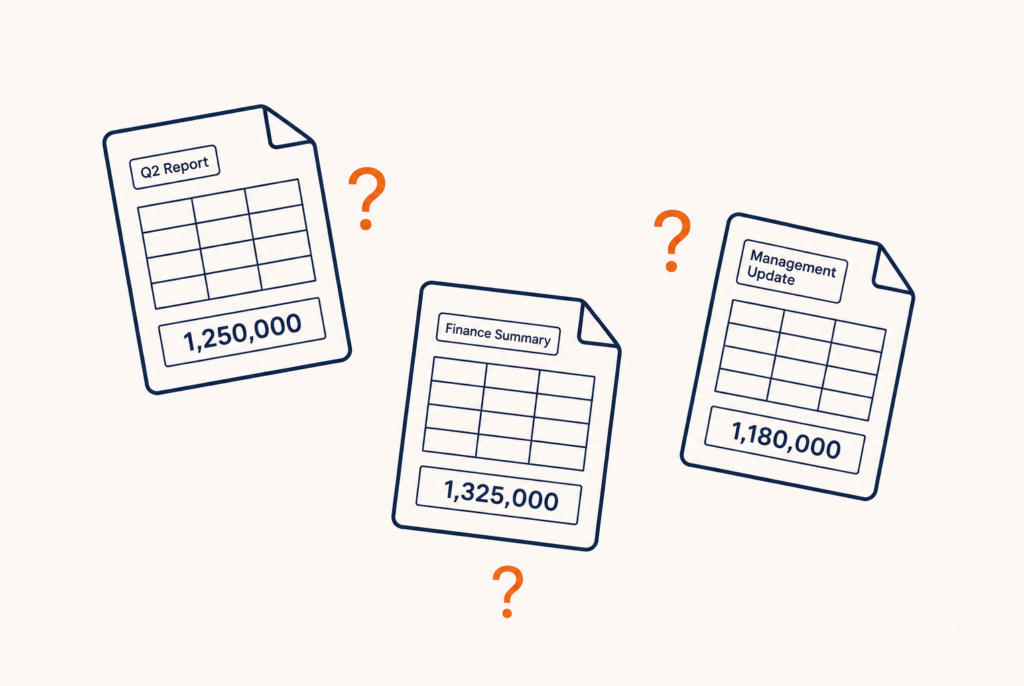
This is where the real cost shows up. Meetings turn into debates about whose spreadsheet is correct instead of what to do next. The business ends up flying a little more blind than it should, given how much data it is actually sitting on.
Why It Gets Worse as a Company Grows
Small companies can often get away with a patchwork of spreadsheets and personal systems. One or two people hold the whole picture in their head, so it works well enough. That stops working once a company crosses a certain size. More locations and more product lines mean more people making decisions on their own, and the informal system that used to work starts to break in specific, painful ways.
This is usually the point where a company invests in a new dashboard, a new BI tool, or a new hire to fix reporting. Sometimes that helps. Often it just adds a sixth version of the truth to the five that already existed. The underlying problem was never really about tooling. Nobody owned a single, agreed upon definition of what the numbers actually mean.
A dashboard cannot fix that on its own. If two departments still disagree on how to define an active customer, a new dashboard will just make the disagreement look more official.
What Actually Stops These Mistakes
The companies that get this right are not the ones with the most sophisticated tools. They treat their numbers the way they treat any other part of the business that has to be reliable. There is a clear owner, a clear definition, and a clear source everyone agrees to use, even when that is inconvenient.
A few unglamorous things tend to happen at once in these companies. Someone agrees, across departments, on what each core number actually means before anyone builds on top of it. The systems that produce those numbers talk to each other automatically. Nobody has to remember to update three spreadsheets by hand. Someone builds the reporting itself so that a hard question gets a fast answer, a few clicks away instead of a multi day scramble.
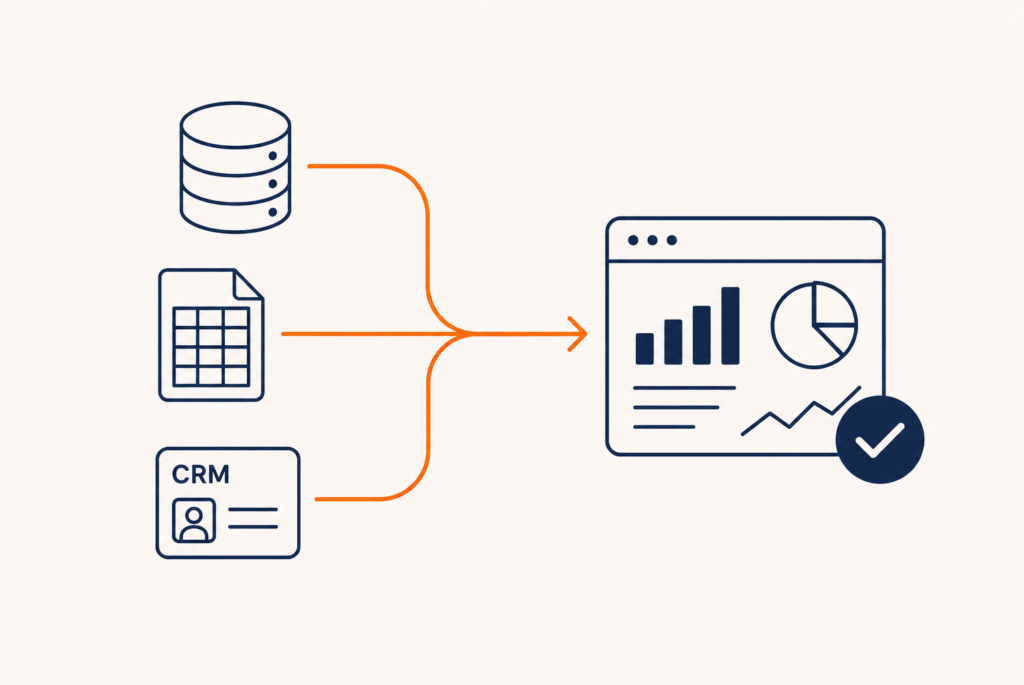
None of that is exciting work. It is closer to plumbing than to strategy. Still, it is the difference between a company that trusts its own numbers enough to move fast, and one that keeps paying for the same costly data mistakes every quarter. If you want a clearer picture of where your own reporting stands, our Analytics Readiness Assessment walks through exactly that before you invest in fixing anything.
The Real Question Worth Asking
The next time a decision in your company stalls, think about why. Did it stall because you were missing information? Or did it stall because you had too many versions of that information, with no fast way to tell which one to trust?
For most mid-market companies, it is the second reason far more often than the first. That is a fixable problem. Fixing it tends to matter more to the bottom line than almost any other single change a growing company can make.
How Swift Insights Solves This
This is exactly the gap we spend our time closing. Swift Insights works with mid-market companies to turn scattered, conflicting numbers into one system everyone in the business actually trusts. We are a certified partner across Tableau, Salesforce, Microsoft, HubSpot, and Sigma. We do not hand a client off to a junior team once you sign the contract. The same person who scopes the engagement builds it and delivers it, start to finish.
We have helped a retail client turn forty separate marketing reports into one dashboard. The business could act on it the same day the numbers landed. We have helped a logistics company cut the time it took to answer a basic revenue question from days down to minutes. That is the kind of result we aim for on every engagement, not the exception.
If your company is losing time to costly data mistakes, the fix is rarely more tools. It is one trusted system that someone builds and owns properly from the start. Book a free consultation with Swift Insights. We will walk through where your reporting stands today, and what closing that gap would look like for your business.