
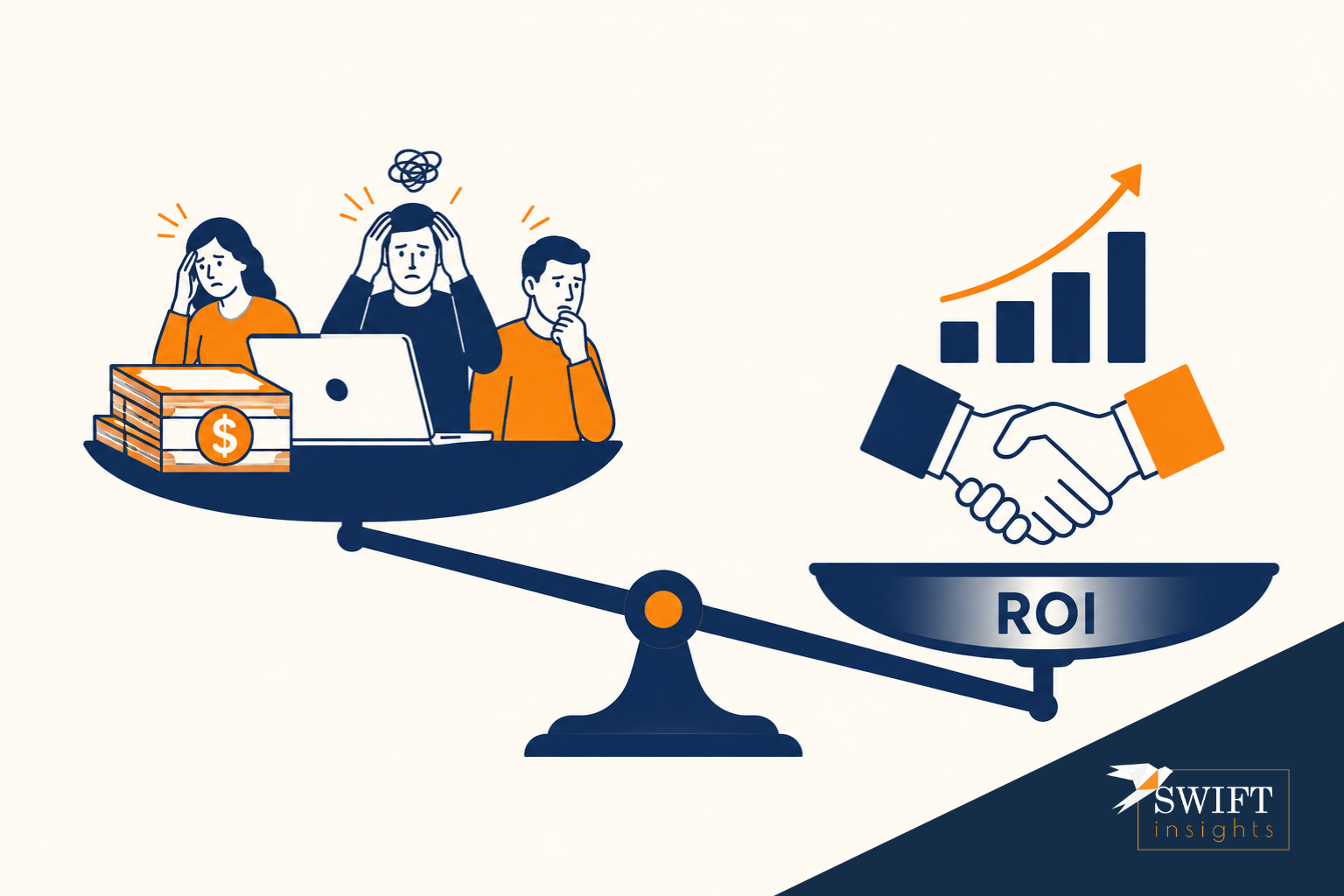
We have met with a lot of leaders lately who stop us mid-conversation with some version of the same sentence. “We have it sorted internally.” And every single time, we pause, not because we doubt them, but because we genuinely get curious and start doing the math quietly in our heads. A 150 to 200 person company. An internal analytics setup they are proud of. We find ourselves wondering just how exceptional those people must be to have built something that handles everything, from the pipelines and warehousing to the dashboards, the governance, the maintenance, the reporting cycles, and still leave time to actually drive business decisions.
Because building and maintaining an analytics function internally is not just expensive. It is one of the most quietly expensive decisions a mid-market company can make, and most leaders do not fully realize the cost until it is already compounding beneath the surface.
What Outsourcing Analytics ROI Looks Like in Real Numbers
Let us put concrete numbers on the table rather than speaking in generalities. A typical all-in cost for a mid-market company building an internal analytics function ranges from $25,000 to $500,000 per year for software and infrastructure alone, with an additional $400,000 to $800,000 per year in salary and benefits for the professional data team needed to support and maintain it.
That means a mid-market company with even a modest internal analytics setup is spending somewhere between $425,000 and $1.3 million every single year just to keep the lights on, and that is before accounting for recruitment costs when someone leaves, onboarding time for replacements, licensing upgrades, tool migrations, and the inevitable periods where the team is so buried in maintenance that no one is actually generating the insights leadership needs.
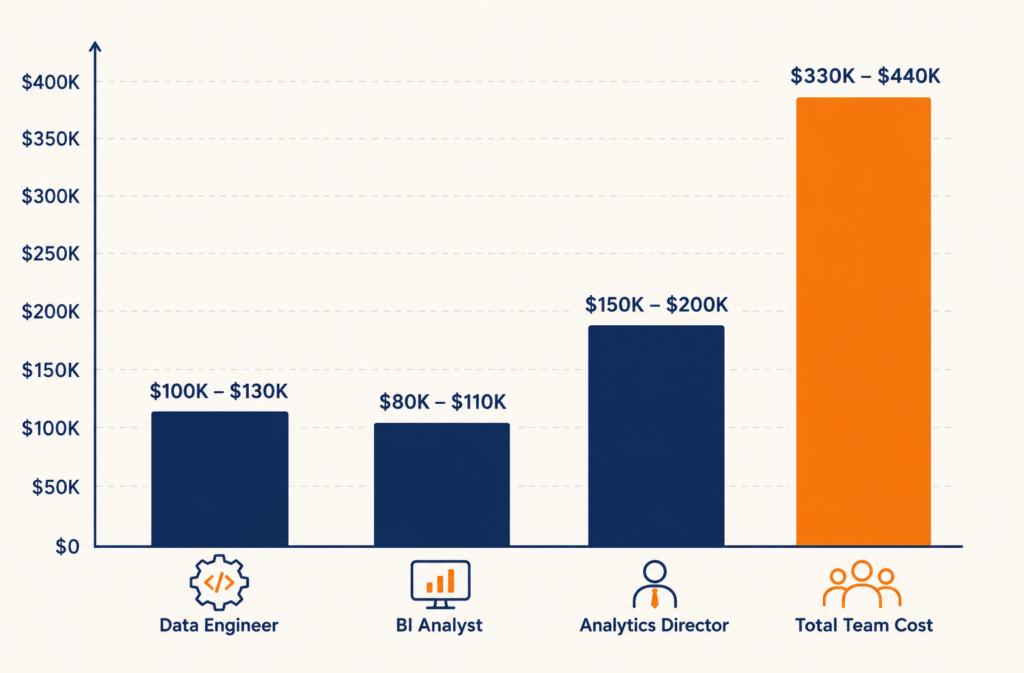
To put individual roles in perspective, the average annual salary for a data analytics professional in the United States sits at $113,873 as of 2026. A data engineer focused on pipelines and infrastructure averages between $95,000 and $130,000 annually, while a BI analyst building and maintaining dashboards sits between $85,000 and $110,000. A director of analytics overseeing the entire function earns an average of $184,828 per year. Hire three people to cover those functions at a mid-market level and the salary line alone reaches $400,000 before a single benefit, bonus, or tool license is accounted for.
The Real Reason Your Internal Analytics Team Is Costing More Than You Think
Here is the part that most leaders overlook entirely. The people on your internal analytics team are not just expensive in terms of salary. They are expensive because they are consistently redirected toward work that falls well below their actual capability and strategic value.
Your internal team understands your business in ways that no external partner ever will from day one. They know the context behind the numbers, the history behind the metrics, and the organizational dynamics behind every reporting request that lands in their inbox. That institutional knowledge is genuinely irreplaceable, and it is precisely what should be driving how your data function creates value for the company.
The reality, however, is that most of them are not spending their time on that work. Instead, they are writing ETL jobs, maintaining pipeline connections that break whenever a source system updates, and rebuilding dashboards because a filter stopped working. They are spending Monday mornings reconciling numbers that do not match across two reports that were supposed to be pulling from the same source, and responding to ad hoc requests that pile up faster than any team of two or three people can sustainably manage.
Running a data analytics platform in 2026 carries monthly operating costs between $75,000 and $105,000, with personnel costs representing the largest expense category. The majority of that cost is not being spent on insight generation. It is being absorbed by infrastructure maintenance that a dedicated external partner could handle at a fraction of the total cost, freeing your internal team to do the work that only they can do.
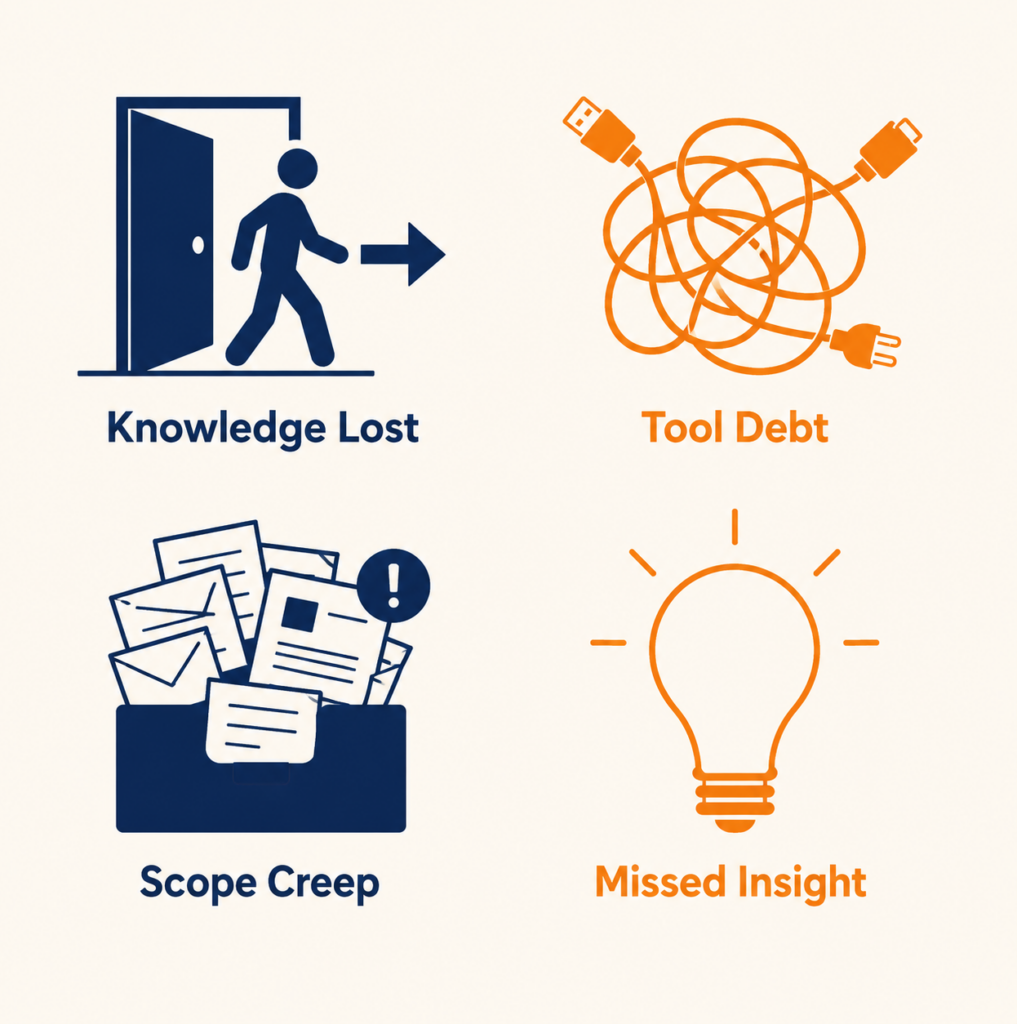
Four Hidden Costs That Never Show Up on the Budget Report
Most leaders compare outsourcing analytics ROI to the visible cost of their internal team, looking at salary lines and tool subscriptions and concluding that internal is cheaper. Almost without exception, that conclusion is wrong because it ignores four costs that rarely surface clearly on any budget report.
- Turnover and knowledge loss: Data professionals are among the most in-demand and mobile workers in the current market. When one leaves, the cost is not just the salary gap. It includes the loss of institutional knowledge, the tribal understanding of your systems, and typically three to six months of degraded productivity while a replacement gets up to speed.
- Tool sprawl and technical debt: Every analyst has preferences, and every new hire brings a slightly different approach to the stack. Over time, internal analytics environments accumulate technical debt in the form of legacy tools, deprecated pipelines, and inconsistent data models that nobody wants to take ownership of cleaning up.
- Scope creep beyond headcount: Internal teams almost always get pulled in more directions than their headcount can support. The CFO wants a new revenue model, the COO wants operational dashboards, and the sales team wants pipeline reporting. A team hired to maintain three dashboards quietly becomes responsible for twelve, and the quality of all of them suffers as a result.
- The opportunity cost of strategic work that never happens: Every hour your analytics team spends on pipeline maintenance is an hour they are not spending on analysis that could change a business decision. That cost is invisible on the budget but enormous in practice, and it compounds silently over time.
How Outsourcing Analytics Delivers Remarkable ROI With Swift Insights
When mid-market companies partner with Swift Insights, the goal is not to replace their internal team but to redirect it toward the work that actually matters most. The execution layer, covering data pipelines, warehouse architecture, dashboard development, infrastructure maintenance, and platform integrations across Snowflake, dbt, Tableau, Power BI, Sigma, and Salesforce, sits entirely with our team. Because we are certified across all of these platforms and maintain these capabilities continuously across multiple clients, our expertise stays current and the cost gets distributed in a way that no single internal hire can match.
As a result, your internal team stops spending their time keeping the engine running and starts spending it on what they genuinely know better than anyone else. The business context, the strategic questions, and the conversations with leadership that turn data into decisions worth making. The analytics function becomes faster, more reliable, and more cost-effective, and it no longer depends on any single hire staying in their seat.
See the Outsourcing Analytics ROI Numbers for Yourself
We built a calculator specifically for this conversation because we believe every leader should be able to run their own numbers rather than taking anyone’s word for it. If you have ever wondered whether building and maintaining your analytics environment internally is actually cheaper than partnering with Swift Insights, the answer is waiting for you at our Build vs Buy Calculator: https://build-vs-buy-calculator.netlify.app
Most leaders who work through the calculator are genuinely surprised, not because the numbers are dramatic on their own, but because they had never added them all up in one place before. The total cost of internal analytics is almost always higher than the number living in any single budget line.
The Question Worth Sitting With
If your internal analytics team disappeared tomorrow, how long before your business decisions started breaking down? And if that question makes you uncomfortable, the follow-up is worth asking too. How much of what they are doing every day actually requires them specifically, and how much of it is work that a dedicated partner could handle better, faster, and at a meaningfully lower total cost?