
A mid-market company invests in a data team. They hire experienced analysts, buy the right tools, build dashboards, and schedule reports. Leadership still does not use any of it. The CFO pulls up a spreadsheet in the meeting. The CEO asks the same question for the third week in a row. And nobody can explain why proven data teams fail mid-market leaders the way they consistently do.
It is not a talent problem. It is not a tool problem. The teams doing this work are capable. The software is mature. What is missing is the connection between the data being produced and the decisions that actually need to be made. That gap is what this post is about, and it is one Swift Insights sees in almost every mid-market engagement we take on.
Why Proven Data Teams Fail Mid-Market Leaders in the First Place
The first thing we do when we meet a new client is not audit their tools or review their dashboards. We sit down with the team that uses those dashboards and ask one question: what decision did this help you make last week?
The silence that follows is the answer.
Proven data teams produce output. They hit their deadlines, publish their reports, and respond to requests. What they often do not do is produce decisions. The difference between those two outcomes is not effort. It is whether the work is connected to a question that leadership is actively trying to answer.
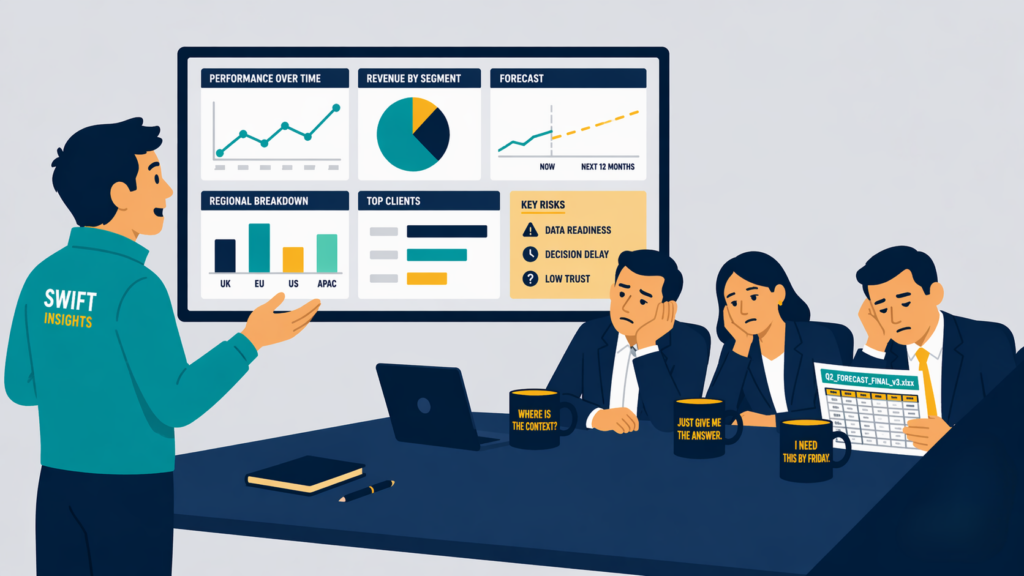
According to Gartner, organizations that align their data and analytics strategy to specific business outcomes — revenue growth, cost savings, risk management, and customer value — are measurably more likely to secure executive support than those that position data as a generic capability available to everyone for everything. Gartner Most mid-market data teams are built as generic capabilities. That is where the failure starts.
The Sequencing Problem That Makes Proven Data Teams Fail
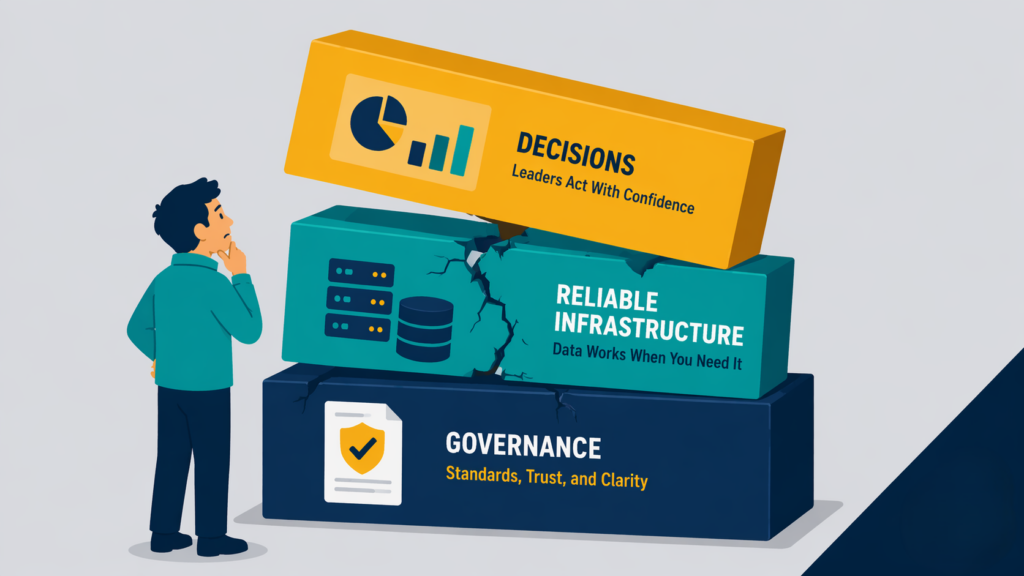
The second reason proven data teams fail mid-market leaders is a sequencing problem that usually predates the team itself. Tools get bought before governance exists. AI initiatives get launched before the data supporting them is clean enough to trust. Technical debt accumulates quietly until it starts consuming the team from the inside.
According to Stripe’s Developer Coefficient Report, developers spend more than 40 percent of their time dealing with technical debt rather than building new capabilities. In data teams, that debt shows up as broken pipelines, inconsistent definitions, slow queries, and dashboards that give different numbers depending on which filter is applied. Small fixes turn into constant firefighting. New work slows down. Trust in data drops.
Gartner research is clear that organizations tying governance to business outcomes and AI readiness will pull ahead, while those treating governance as a compliance exercise will fall behind. Atlan Governance is not a cleanup task. It is the foundation that determines whether everything built on top of it is worth using. When it is absent, automation and AI do not solve the problem. They amplify it. Before adding more capability on top, most mid-market organizations need to fix what is already underneath — a pattern we explored in depth in Deploying AI Analytics: 3 Dangerous Mistakes Data Leaders Make.
What Dashboard Design Reveals About Mid-Market Data Strategy
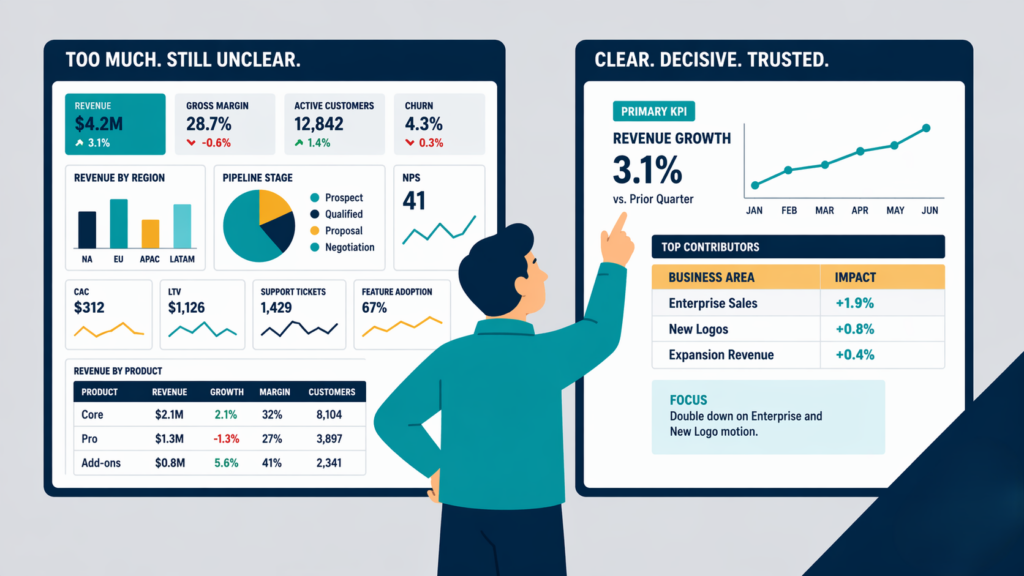
The third reason proven data teams fail mid-market leaders shows up in how dashboards are designed. When the underlying strategy is unclear, dashboards try to show everything. Too many metrics compete for attention. Leadership cannot find the number that matters. The dashboard becomes a reporting artefact that nobody opens unless someone asks for it specifically.
Good dashboard design is not primarily an aesthetic discipline. It is a reflection of how clearly the data strategy has been defined upstream. When the strategy is clear, the dashboard question is clear. When the question is clear, the layout follows naturally. One primary metric per chart. Supporting metrics that explain it directly. Contrast used to direct attention rather than add noise. Sections that build on each other in a logical sequence from performance to trend to contributors.
The dashboards that leadership actually uses share a common quality. Nothing competes for attention. Everything earns its place. That kind of clarity does not come from better design software. It comes from knowing in advance what decision the dashboard is supposed to support. If your dashboards are not driving decisions, the root cause is almost always upstream — and it starts with data visibility for decision making.
The Three Layers That Fix It
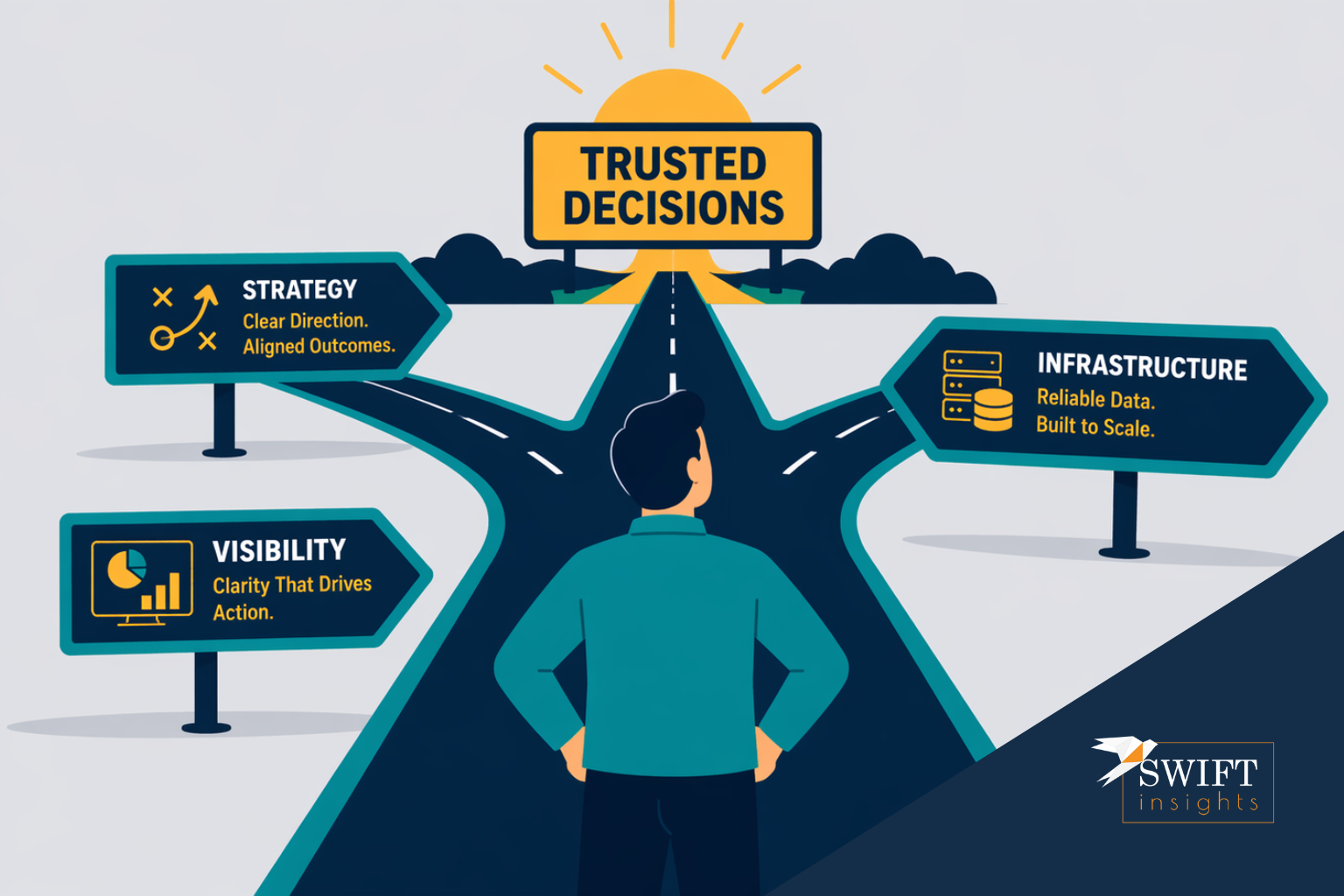
When proven data teams fail mid-market leaders, the fix almost always operates across three layers simultaneously.
The first layer is strategic alignment. Every data initiative needs to connect to a specific decision that leadership is actively trying to make. If a dashboard cannot answer the question of what decision it supports, it should not be built yet. This is the layer most mid-market data teams skip because it requires conversations with leadership that feel outside the scope of data work. They are not outside that scope. They are the entire point of it.
The second layer is infrastructure reliability. Pipelines, data definitions, access controls, and governance frameworks need to be stable before analytics can compound in value. Organizations with AI-ready data and analytics foundations see a 20 percent improvement in AI-related business outcomes compared to those without that foundation in place. Gartner The same multiplier applies at the dashboard and reporting layer. Reliable infrastructure is not a cost. It is what makes everything else worth building.
The third layer is visibility design. How data is presented to leadership determines whether it gets used. Focused views that answer one clear question are easier to read, easier to trust, and easier to act on. That trust, built decision by decision, is what separates data teams that inform leadership from data teams that lead it.
Why This Matters More Now Than It Did Two Years Ago
The pressure on mid-market data teams has increased sharply. AI ambitions have outpaced data foundations in most organizations. Governance is being asked to do more than it was ever built to do. Leadership expects faster answers from data that has never been more complex to manage.
Gartner notes that nearly everything, from the way organizations work to how they make decisions, is now directly or indirectly influenced by AI, but that AI does not deliver value on its own. It needs to be tightly aligned with data, analytics, and governance to enable intelligent, adaptive decisions across the organization. Gartner That alignment is exactly what breaks down when proven data teams fail mid-market leaders. The teams are capable. The technology is real. The foundation underneath both is what needs attention.
If you asked your leadership team today what decision your most-used dashboard helped them make last week, what would they say?